Buying Used Versus New Brewery Tanks
A used tank can save money on paper and cost more than a new one in practice, because the things that fail — welds, jackets, seals and fittings — are exactly the things a photograph cannot show. New vessels from the factory arrive with a pressure-testing record, a data plate and a serial number; a tank bought from a broker usually arrives with neither. Hermann has built brewing equipment for 23 years, and the paper trail is where that experience shows most clearly.
Key takeaways
- Ask for the pressure-testing record and the serial number before you ask for the price on any second-hand vessel.
- New equipment from the factory carries a published 6-year warranty on tank accessories and electronic components, used within scope; used gear carries whatever the seller will write down.
- One failed vessel in a five-tank set can cut weekly capacity by a fifth while the repair runs.
- Fittings that no longer match the rest of the cellar cost more in adapters than they save at purchase.
What a used tank cannot show you
Stainless steel is forgiving but not indestructible. A vessel that has held cleaning chemicals at the wrong concentration, been stored outdoors with the manway open, or been hauled across a yard by forklift may look sound and still fail a jacket pressure test on your own floor. Inlet and outlet threads, gaskets, spray balls, sample valves and manway seals are all wear items, and replacing a set of them on four tanks is a real cost that rarely appears in the asking price.
There is also a matching problem. A used tank is often the only one of its kind in the building: a different cone angle, a different cooling jacket layout, different ports. Adapters, spare gaskets and a second training routine follow. Where a brewery intends to grow on a standard vessel, a mixed cellar makes every later expansion more complicated.
An inspection on site is still worth the trip, and it should be a wet test rather than a walk-around. Fill the jacket, hold the pressure and watch the gauge and the welds; check the polish on the inner surface for scratches and any sign of pitting; turn the manway and inspect the seal groove; look at every port for cross-threading and every leg and foot for impact damage. Then price the tank as if the fittings all have to be replaced, because on a used vessel several of them usually do.
Data plates, pressure records and the paper trail
Every tank built by the manufacturer carries a data plate with its pressure-testing record and serial number, so a vessel can be identified years after delivery. That plate is the difference between buying a known tank and buying an unknown one. Before money changes hands on a used vessel, photograph the plate, write the serial number into the contract and ask for the original test documentation, not a copy of a copy.
On new equipment the trail is produced as part of the build. Materials are checked, the production process is watched, jackets are pressure tested, finished equipment is leak tested, and packing and loading are inspected — five inspection steps behind every shipment, with the record travelling with the order. A checking list also arrives with the crates, so the delivery can be reconciled line by line before the crates are broken down.
Warranty cover: what new tanks include
The published warranty for this equipment runs 6 years on tank accessories and electronic components against manufacturing defects from the factory, provided they are used within scope. That is a specific, component-level term, and it is worth reading twice: it is not a promise that nothing will ever wear out, and it does not travel with a tank sold on to a second owner.
On a used purchase, cover is whatever the seller agrees in writing, and most private sales come with none at all. Ask the seller what they will stand behind, in what period and against what failure, and be sceptical of a verbal assurance offered at the loading dock.
| Item | New vessel from the factory | Used vessel from a third party |
|---|---|---|
| Pressure test | Jacket pressure test plus a finished-product leak test | Rarely documented; ask for a test on site |
| Identification | Data plate with pressure record and serial number | Plate often missing or unreadable |
| Warranty | 6 years on tank accessories and electronic components, used within scope | Whatever the seller states in the contract, often nothing |
| Fittings | Standard ports and gaskets, spares available | Mixed sizes and thread forms, adapters needed |
| Timing | 90–150 days from deposit to door delivery | Available now, but the repair clock starts on arrival |
Worked example: one failed tank in a five-tank order
Example, with assumptions stated. A brewery plans five 1,000 litre tanks and brews twice a week on each. The full set would give 5 × 1,000 × 2 = 10,000 litres a week. One of the five fails its on-site jacket test after a used purchase and needs two weeks of repair, so only four tanks are in service for the first eight weeks: 4 × 1,000 × 2 = 8,000 litres a week. The shortfall is 10,000 − 8,000 = 2,000 litres a week, and 2,000 × 8 = 16,000 litres lost across the eight weeks — before the cost of the repair itself.
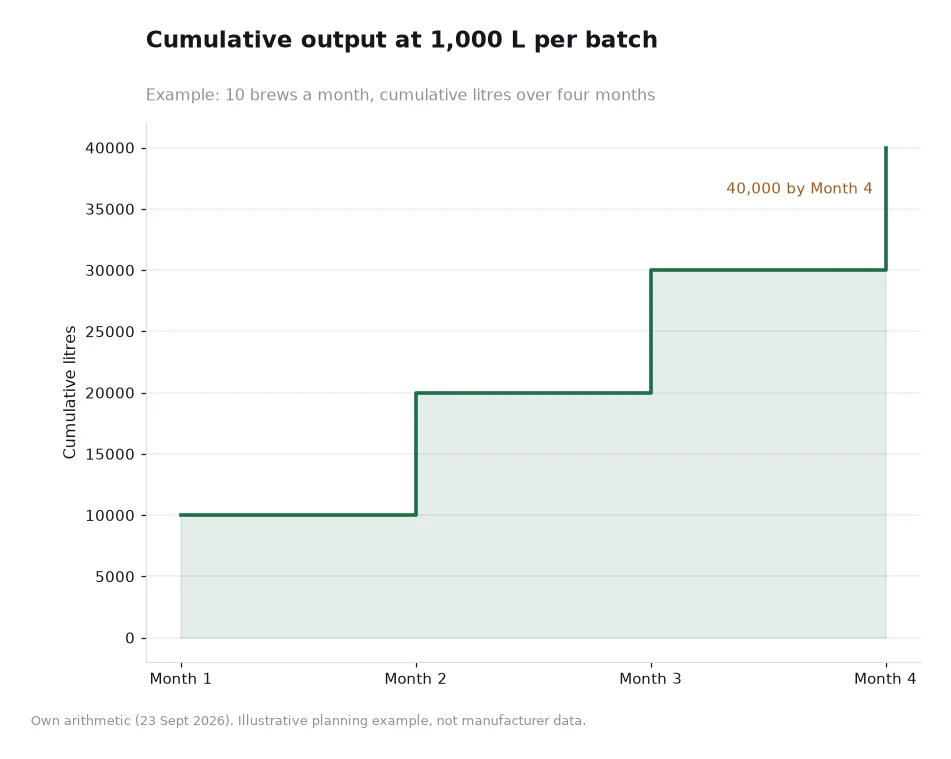
Compare that with the normal ramp once everything runs. Ten brews a month on 1,000 litres gives 10,000 litres in month one; holding that rate the cumulative total becomes 20,000 litres by the end of month two, 30,000 by month three and 40,000 litres by month four, as the step chart below shows. Those are capacity figures with no allowance for losses or slow sales, but they make the point: lost weeks early in the year are hard to recover later.
Frequently asked questions
Does the warranty transfer if I buy a second-hand brewery tank?
The published 6-year cover runs on tank accessories and electronic components against manufacturing defects from the factory, used within scope, and it applies to equipment supplied new by the manufacturer. On a used purchase you rely on whatever the seller writes into the contract.
What should I check first on a used tank?
Start with the data plate, the pressure-testing record and the serial number, then inspect the jacket, welds, manway seal and ports. If the paperwork is missing, price the vessel as unverified and test it on site before paying.
Making the choice
Used tanks have a place in a growing brewery: a spare bright tank, a short-term capacity fix or a pilot vessel. The mistake is making a used purchase carry the whole plan, because the delivery timeline, the warranty term and the fittings then have to be managed on the back foot.
Buyers who want certainty usually start with a new vessel set and one standard tank design; buyers who need capacity this month often buy a single tank from a hem craft beer equipment supplier or a broker and accept the paperwork risk. What a new order covers is listed under the manufacturer's brewery equipment pages, the hot-side configuration is described in the brewing house section, and questions about a specific used vessel can be put to the engineers through the contact page. For anyone still weighing the two routes, the deciding question is simple: how many weeks of lost production can this brewery absorb?
Published figures in this article come from the manufacturer's own website, read 23 Sept 2026: the five inspection steps on every shipment, the tank data plates with pressure-testing record and serial number, the 6-year warranty on tank accessories and electronic components against manufacturing defects from the factory, used within scope, and the 90–150 day deposit-to-door delivery window. The weekly capacity and cumulative output figures are this article's own labelled examples, not manufacturer data.[1]