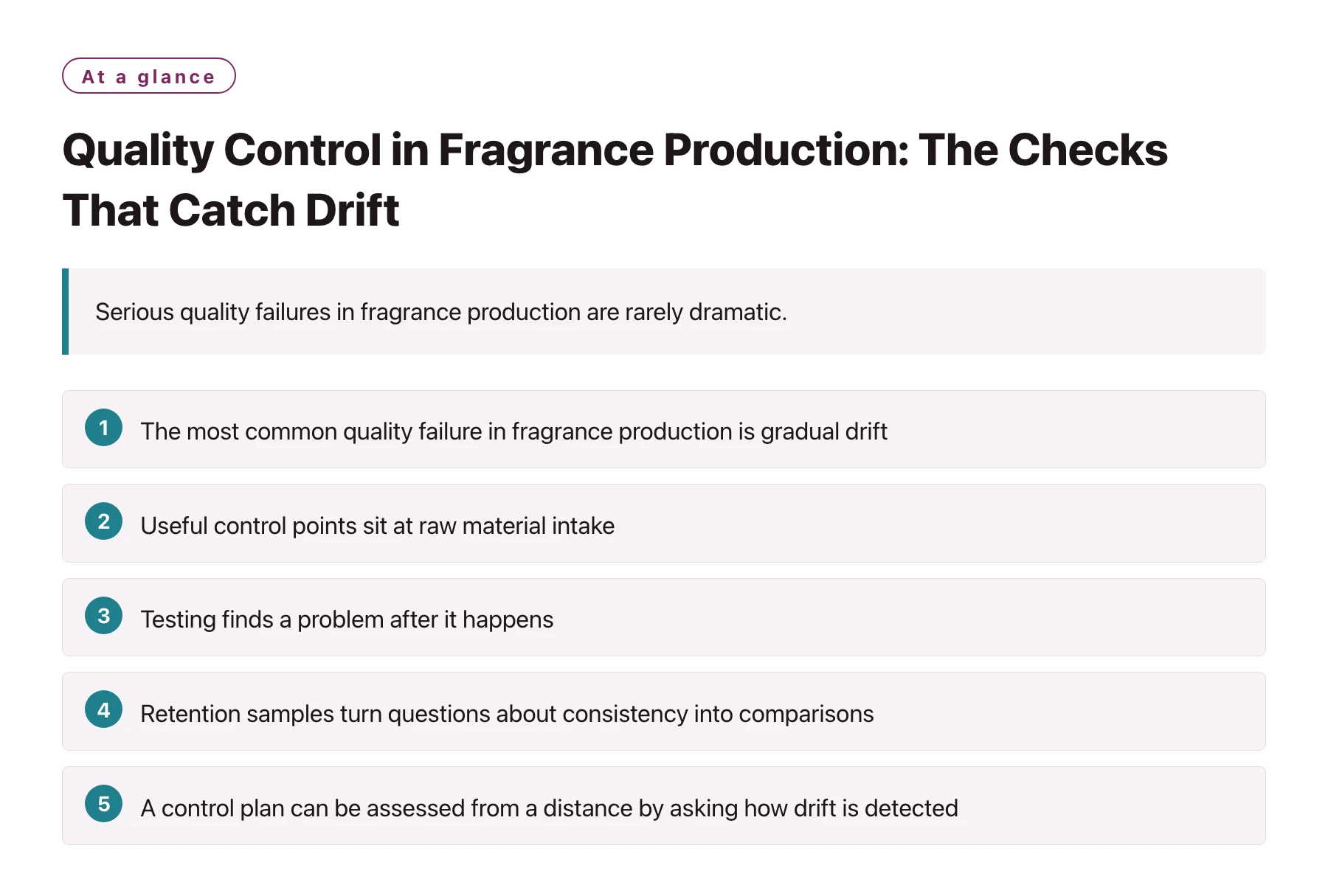
Serious quality failures in fragrance production are rarely dramatic. A batch is not usually contaminated or catastrophically wrong; it drifts a little, and the drift only becomes visible across a pallet, a season or a reorder. Quality control earns its place by catching those small movements early, at checkpoints that cost minutes rather than at the point where a customer notices.
Key takeaways
- The most common quality failure in fragrance production is gradual drift, not a single dramatic defect in one batch.
- Useful control points sit at raw material intake, compounding, resting, filling, packing and release against a retained reference.
- Testing finds a problem after it happens, while in-process control keeps the batch inside tolerance while it is still fixable.
- Retention samples turn questions about consistency into comparisons, which is why they belong with the batch record.
- A control plan can be assessed from a distance by asking how drift is detected, recorded and corrected.
Buyers often picture quality control as a final inspection: a batch is produced, a sample is tested, and the goods are released or rejected. That picture is incomplete, because by the time a batch reaches final inspection most of the decisions that determined its quality have already been made.
The checkpoints below are arranged in the order a batch moves through them. Each one answers a specific question, and each one exists because the industry learned that the question is cheaper to ask early.
The checkpoints a batch passes through
- Raw material intakeConfirm identity and compare the delivered lot against its specification and documentation before anything is weighed.
- Compounding and weighingVerify the weights and the order in which materials are combined, with a second check on any material that dominates the formula.
- Bulk resting checkLet the compounded bulk settle for the agreed period, then evaluate it before it is committed to filling.
- In-process fill controlSample fill weight during the run rather than only at the start, because fillers drift as a line warms up.
- Packing and decorationInspect print registration, label placement and closure torque against the approved sample, not against memory.
- Release against the referenceCompare the finished batch with the retained reference sample, then archive a retention sample with the batch record.
What control is actually protecting against
Three ideas explain almost every control decision on a fragrance line: drift is the real enemy, prevention beats detection, and the written record is what makes both possible.
Drift is gradual by nature
A raw material lot that is slightly different, a weighing that is a fraction off, a filler that runs marginally light, a resting period cut short by a busy week: none of these produces an obviously bad bottle. Together they produce a product that a returning customer describes as not quite the same.
Because drift is gradual, it is invisible to single-batch inspection and obvious to a trend. Controls that record a value every batch create the trend.
Testing finds problems; control prevents them
Laboratory testing answers whether a sample meets a specification. In-process control answers whether the batch is still inside tolerance while there is time to adjust it. A supplier with strong testing and weak in-process control will find defects reliably and prevent them rarely.
Independent laboratories such as SGS test cosmetics, personal care and household products against GMP and conformity requirements, and how far that testing reaches is a commercial decision as much as a technical one [1]. The same is true of material restrictions: the International Fragrance Association publishes standards that limit how much of certain materials may be used and in which product types, and intake is the last practical moment to catch a mismatch [2].
The record is the plant's memory
Without written records, every batch is judged on its own and no one can tell whether a difference is new or longstanding. That is why the practical question during an audit is not whether the lab exists but what happens to the numbers it produces.
Failure modes and the check that catches each one
| Failure mode | Where it shows up | Check that catches it | Corrective move |
|---|---|---|---|
| Raw material lot variation | A slight odour shift in the bulk | Identity and specification verification at intake | Reject the lot and request compliant documentation |
| Weighing error | One facet of the scent reads wrong after resting | Recorded weighing against the formula, with a second check | Rebuild the affected portion before filling |
| Fill weight drift | Customers notice short fills before any lab does | In-process weight sampling through the run | Adjust the filler and re-inspect the affected units |
| Decoration misregistration | Print or label sits off-centre across a run | Visual inspection against the approved artwork | Hold and rework the affected units before packing |
| Odour drift after storage | The product smells different weeks after delivery | Retention samples reviewed over time | Review resting time, storage conditions and the pack |
Read the third column as the minimum viable control plan. Every one of those checks can be performed with ordinary equipment and a written procedure; what makes them work is that somebody owns the number and compares it batch to batch.
Certificates are a starting point for a quality conversation, not the conclusion of one. ISO 22716, GMPC, ISO 9001, ISO 14001 and ISO 45001 describe management systems, and a system can be well documented and loosely followed. The questions that separate the two are concrete: who checks fill weight and how often, what happens when a value sits at the edge of tolerance, how long a retention sample is kept, and who signs a batch off for release. It is fair to ask the Xuelei brand which certifications sit behind a specific production line, and it is equally fair to follow that answer with the four questions above.
Auditing a control plan without a factory visit
Not every brand can send someone to the plant before a first order. A remote audit is limited, but it can still separate a real control plan from a folder of certificates.
Ask for one batch record, redacted
A single batch record, with commercial details removed, shows the sequence of checks, the values recorded and the sign-off. If the supplier cannot share even a redacted example, expect the same opacity after an order is placed.
Ask how tolerance edge cases are handled
Every plant meets a batch that sits near the boundary. The answer reveals whether there is a defined procedure or whether the decision depends on how urgent the shipment is.
Ask who owns release
Quality control is only meaningful if the person releasing a batch can also stop it. Ask who holds that authority and whether the answer changes when a delivery date is tight.
Sources
- SGS: Cosmetics, Personal Care & Household Testing —— Testing, inspection and certification services for cosmetics and personal care, including microbiological, stability and safety testing aligned with cosmetics GMP.
- IFRA Standards Library (International Fragrance Association) —— The IFRA Standards Library lists the restrictions the fragrance industry applies to individual fragrance ingredients, based on safety assessments; it is the reference point for compliant fragrance formulation.
Frequently asked questions
How often should fill weight be checked during a production run?
Often enough to see a trend rather than a snapshot. Checking only at the start misses drift as the line warms up, and checking only at the end is inspection rather than control. The right interval depends on the filler, the run length and the tolerance band the brand has agreed.
What is a retention sample and why does it matter?
A retention sample is a sealed unit kept from a production batch under known conditions. It is the reference that makes later questions answerable: whether a complaint batch differs from what was approved, whether a formula has drifted across reorders, and whether a change came from production or from storage.
Do third-party certificates replace in-house quality control?
No. Certificates describe a management system that has been audited, while day-to-day control describes what actually happens on a specific line and batch. The two are complementary, and a brand buying a first order benefits more from evidence of routine control than from the certificate alone.
What should I do if the bulk batch does not match the approved sample?
Hold the batch and review it before filling, because a difference in bulk is usually easier and cheaper to correct than a difference discovered in finished goods. Ask which variable changed, whether the raw material lot or the process was different, and what the corrected batch will be compared against.
How does quality control differ between alcohol perfumes and home fragrance?
The core checkpoints are similar, but the emphasis shifts. Alcohol products need close attention to fill volume, closure integrity and odour consistency, while home fragrance and body products often add checks on base compatibility, wick or sprayer performance, and colour stability in the finished pack.