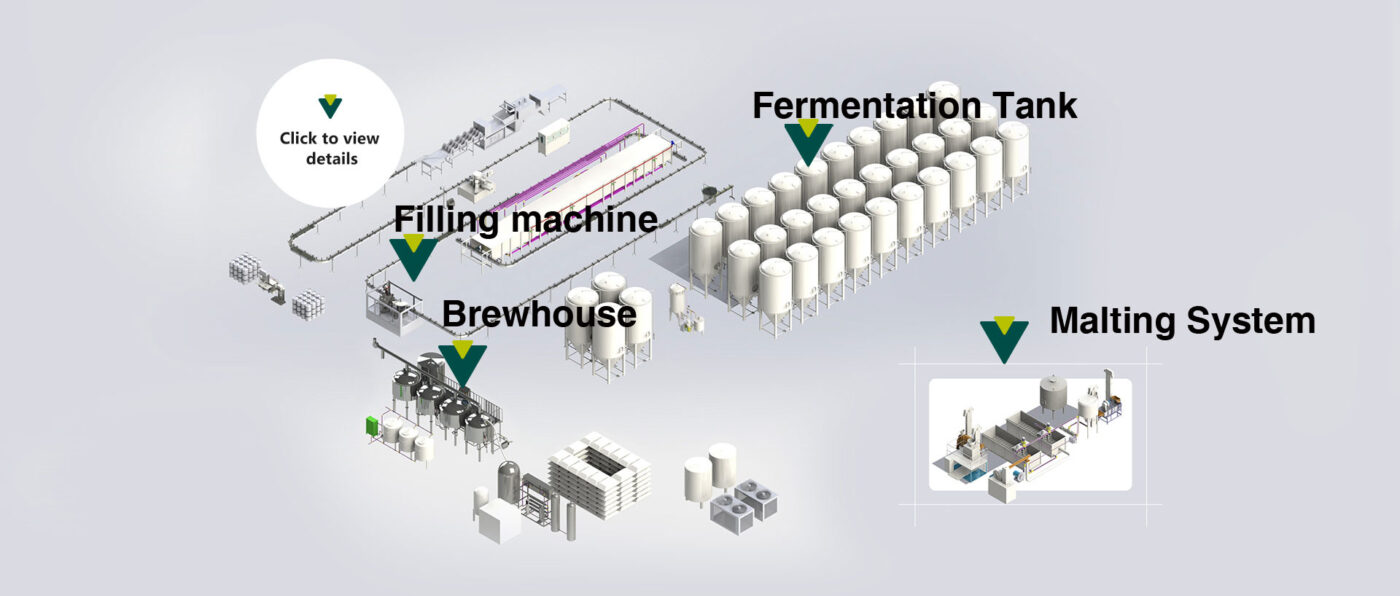
Turn-key brewery solutions handle brewing and packaging by sizing the brewhouse, fermentation cellar, utilities, and filling line as one production system. A 20 hL brewhouse running two batches per day can produce about 40 hL of wort, so fermentation capacity, glycol cooling, bright beer storage, and packaging speed must support that volume. A 3,000-bottle-per-hour line needs roughly three hours to package 30 hL in 330 mL bottles before downtime is counted. Good system sizing reduces idle tanks, packaging delays, unnecessary transfers, and oxygen exposure while keeping brewing, cleaning, cooling, and filling capacity within the same production schedule.
The process normally starts with annual output, batch size, beer style, fermentation time, and packaging mix. A brewery targeting 10,000 hL per year has different needs from a 2,000 hL brewpub even if both use a 20 hL brewhouse. If one site brews five days per week and another brews only twice, the required number of fermenters changes substantially. Ales may occupy a tank for 10–18 days, while many lager schedules can extend beyond 21 days, so tank occupancy has to be calculated before equipment is ordered.
That calculation then determines how the hot side should be arranged. A two-vessel brewhouse combines more functions in fewer tanks, while three- or four-vessel systems separate mashing, lautering, boiling, and whirlpool work to shorten overlap between batches. In a commercial system, wort boiling commonly removes around 4–10% of volume per hour, depending on kettle geometry, heating method, elevation, and operating practice. The supplier therefore needs to match vessel working volume, heating area, steam capacity, pumps, and heat-exchanger size to the actual brew schedule rather than the nominal tank label.
A 20 hL brewhouse does not automatically produce 20 hL of packaged beer. Grain absorption, trub separation, yeast removal, transfers, filtration where used, and packaging losses reduce saleable volume at several stages.
Loss planning matters because packaging equipment is sized from finished beer, not only from wort volume. If total process yield from kettle to packaged product is 92%, a 20 hL cast-out produces roughly 18.4 hL before any later adjustments. Across 500 brews in a year, an additional 1% loss represents about 100 hL of product. That makes pipe routing, tank bottoms, transfer methods, filler setup, and cleaning procedures financially relevant even when each individual loss appears small.
Fermentation design follows the production rhythm. A brewery producing 40 hL per day may use 40 hL or 80 hL cylindroconical tanks depending on whether it wants single- or double-batch fills. Double-batching can reduce tank count, but it also requires the second wort batch to reach the fermenter within an acceptable schedule. Fermenters are commonly designed with headspace above working beer volume, often around 20–25%, because fermentation creates foam and requires room for pressure control, cleaning, and gas management.
Cooling capacity has to follow the same schedule. Removing heat from actively fermenting beer requires less refrigeration than dropping several tanks from fermentation temperature to near 0–2°C at the same time. A 4,000 L batch cooled by 18°C requires removal of roughly 84 kWh of sensible heat before allowing for tank heat gain, pump energy, piping losses, or refrigeration efficiency. If four tanks are cooled during the same shift, the chiller and glycol loop must support the combined demand instead of an average daily figure.
The same engineering approach applies to water and heating. Brewing water goes into the product, but breweries also use water for vessel rinsing, CIP, keg washing, packaging sanitation, floor cleaning, and utility systems. Many facilities work to reduce water use from older levels above 7 L of water per liter of beer toward approximately 3–5 L/L, although actual results depend on plant size and process design. Lower usage requires measured rinse volumes, reuse where suitable, proper hose practices, and equipment that can be cleaned without excessive circulation time.
That cleaning requirement affects the design of beer brewing equipment before the first production batch is made. Product-contact piping should drain correctly, spray devices must cover vessel surfaces, and CIP pumps need enough flow and pressure for the circuit being cleaned. Breweries commonly use alkaline cleaning steps followed by rinsing and periodic acid treatment, with concentration, temperature, contact time, and mechanical circulation adjusted for equipment and soil level. A 2% caustic solution, for example, behaves differently from a weak rinse and requires compatible pumps, seals, tanks, and safety procedures.
Once beer reaches the cellar, transfer design becomes more important because oxygen exposure can shorten flavor stability. Many breweries aim to keep dissolved oxygen in packaged beer well below 100 parts per billion, and well-adjusted lines may target much lower levels. Oxygen can enter during tank transfers, filtration, carbonation, hose connection, filler startup, and container filling. Tank pressure, CO₂ purging, product temperature, transfer speed, and filler design therefore have to work together rather than being adjusted separately after installation.
Packaging capacity can then be calculated from the brewery's tank-release schedule. A 40 hL bright beer tank contains about 12,120 cans at 330 mL before product loss. At a nominal speed of 4,000 cans per hour, filling alone requires just over 3 hours at 100% mechanical efficiency. Real lines do not run continuously at their nameplate rate because operators stop for lid supply, container jams, cleaning, coding checks, product changeovers, and seam inspection. At 80% effective efficiency, the same run takes close to 3.8 hours.
| Production item | Example operating figure | Design effect |
|---|---|---|
| Brewhouse batch | 20 hL | Sets wort volume per cycle |
| Daily brew count | 2 batches | About 40 hL cast-out per day |
| Fermenter size | 40–80 hL | Supports single or double batching |
| Packaging speed | 4,000 cans/hour | About 13.2 hL/hour at 330 mL |
| Packaging efficiency | 80% | Extends real run time |
| Packaged DO target | Below 100 ppb | Requires controlled transfer and filling |
Bottle lines require the same capacity matching but use different container handling. A 330 mL glass line processing 3,000 bottles per hour packages about 9.9 hL per hour before efficiency losses. Counter-pressure filling is commonly used for carbonated beer because the bottle is pressurized before liquid enters, reducing rapid CO₂ breakout. Product arriving too warm or at unstable pressure produces more foam, which lowers fill accuracy and slows the filler. For that reason, bright beer temperature and carbonation pressure need to remain stable during the entire packaging run.
Can lines add seaming requirements. The filler places beer into the can, the lid is positioned, and the seamer mechanically forms the double seam between the lid and can body. Operators normally inspect seam dimensions at scheduled intervals because a line running 4,000 cans per hour produces more than 30,000 containers during an 8-hour shift. Even a 0.2% closure defect rate at that volume would involve more than 60 packages, so inspection frequency and setup control matter in daily operation.
Kegging introduces another equipment balance because the container must usually be cleaned before refilling. Semi-automatic systems may process dozens of kegs per hour, while larger multi-head systems can handle much more. A brewery filling 50 L kegs needs 80 kegs to package 40 hL. If the washer-filler processes 20 kegs per hour, the theoretical cycle is four hours before handling delays. Steam or hot water, cleaning chemicals, compressed air, CO₂, drainage, and operator movement all need to support that rate.
Utilities often expose mismatches that are not visible in equipment specifications. A steam-heated brewhouse may require steam for the kettle at the same time the keg washer or CIP station needs thermal energy. Compressed air can serve pneumatic valves, canning equipment, and packaging actuators simultaneously. In a plant commissioned in 2026, utility calculations should include peak simultaneous demand and spare capacity for realistic additions, not only the average consumption printed on individual machine data sheets.
Automation can reduce variation, but the level should fit plant size. A small 10 hL brewery may use manual butterfly valves with automated temperature controllers, while a 50 hL production site may use PLC-controlled pumps, automated valves, recipe steps, tank temperature records, and CIP sequences. Automation is most useful where repetitive timing or control matters. A programmed mash rest at 65°C, for example, can hold temperature more consistently than repeated manual adjustments, while automated valve routing reduces the number of manual hose changes during frequent transfers.
Physical layout has similar effects on labor and sanitation. Tanks need enough overhead clearance for installation and service, packaging lines need accumulation space between machines, and wet areas need floor drainage appropriate for cleaning water. A 4 m tall fermenter cannot be installed through a 3 m access route simply because the final room has a 5 m ceiling. Layout drawings therefore need to check delivery path, tank erection space, pipe rack height, operator access, forklift movement, finished-goods storage, and maintenance clearance before equipment is manufactured.
Expansion planning belongs in the first layout for the same reason. A brewery starting with four 40 hL fermenters may reserve floor space, glycol headers, electrical capacity, and control-panel connections for four more vessels. Adding spare utility capacity during the first build can cost less than replacing undersized distribution systems two years later. A packaging line can also be arranged with enough conveyor and floor space for a later labeler, case packer, or higher-speed filler without rebuilding the entire packaging room.
Commissioning joins all of the earlier calculations. Pumps are checked for rotation and flow, vessels are leak-tested, temperature sensors are verified, glycol valves are tested, CIP circuits are circulated, controls are checked, and packaging equipment is run with water before beer is introduced. During a 2026 installation, a supplier may also provide electrical drawings, process diagrams, maintenance schedules, spare-parts lists, operating procedures, and training records so operators can reproduce the intended settings after the commissioning team leaves.
The final production schedule should connect brewing time, tank occupancy, cold conditioning, packaging hours, and cleaning windows. If a 40 hL fermenter becomes available every two days but the packaging room can clear only 20 hL during the same period, cellar capacity will gradually fill even though the brewhouse itself operates normally. Matching those rates before installation reduces production waiting time, keeps tanks available for the next brew, and gives operators a workable weekly schedule rather than a collection of machines sized from separate brochures.