How Long a Road-Trip Fast Charge Really Takes
Twelve minutes is the published figure for a 10–80% state-of-charge top-up on the New G6, and it is the number to plan a holiday around. What it does not include is the seven or eight minutes at each end — leaving the highway, finding the bay, plugging in, paying, and pulling back onto the road. Budget fifteen to twenty minutes per stop and your trip plan will hold together in the real world.

Key takeaways
- The published 10–80% state-of-charge window is 12 minutes on the 5C battery, which the site headlines as Australia's first 5C AI Battery.
- Up to 427 km of charge in 15 minutes comes from XPENG's internal tests of the G6 RWD Long Range, so it is variant-specific.
- Add roughly 8 minutes per stop for the detour, plugging in and paying on the assumptions used here.
- On a 1,000 km day, three charging stops of 12 minutes plus overheads comes to about 60 minutes of the trip.
The published figure, and what it covers
XPENG publishes 10–80% state of charge in 12 minutes for the New G6 on its 5C battery, and the same 12-minute figure for the X9. Both sit on a full-domain 800V SiC platform, and the G6's platform is described as a Full-Domain 800V High-Voltage SiC Platform with 5C supercharging. A separate published figure, up to 427 km of charge added in 15 minutes, comes from XPENG's internal tests of the G6 RWD Long Range and applies to that variant and that test.
Two things about the 12-minute number are easy to miss. It describes a window from 10% to 80%, not from empty to full, and it describes the battery rather than the whole stop. The window is deliberately chosen because the last part of a charge is the slowest part: pushing from 80% to 100% takes longer than the whole 10–80% sprint, which is why experienced drivers leave at 80% rather than waiting for a full battery.
What the clock does not include
The minutes that surround a charge are the same whether the car is fast or slow, and they are what make a twelve-minute stop feel like twenty. Assume, as a labelled example rather than a published figure, that the detour from the highway to a charger takes two minutes each way, that plugging in and starting the session takes two minutes, and that a payment or app step and a toilet stop take two more. That is roughly 8 minutes of overhead per stop.
On that basis a stop that takes 12 minutes at the battery occupies about 20 minutes of your day. It is still a short break — shorter than a meal stop — but it is honest, and planning with the overhead included is how people stop being surprised by electric road trips. The manufacturer's charging page also notes that these vehicles are compatible with most public Type 2 AC and CCS2 DC fast chargers, so the overhead rarely includes hunting for a plug that fits.
Charge-time arithmetic for a family trip
| Item | Value and source |
|---|---|
| 10–80% state of charge | 12 minutes, published for the 5C battery |
| Charge added in 15 minutes | Up to 427 km, internal test of the G6 RWD Long Range |
| Overhead per stop | About 8 minutes, assumption for this example |
| Stop spacing used here | Every 300 km, assumption for this example |
| Total charging time on a 1,000 km day | About 60 minutes, from the arithmetic below |
Why two short stops beat one long one
Because the charge curve bends. Anyone weighing an XPENG electric suv for holiday driving learns this on the first long trip: the first part of a session moves energy quickly, and the last part does not, so a driver who arrives at 10% and leaves at 55% spends fewer minutes per kilometre added than a driver who insists on filling to 100%. The practical version of this advice is to plan stops around the state of charge you need for the next leg, not around a full battery.
There is a comfort argument as well. Two fifteen-minute breaks across a morning keeps everyone in the car fresher than one forty-minute break in the middle, and the shorter stops are easier to fit into a route where chargers are spaced by distance rather than by convenience.
Home charging is what makes the stop count small
Fast charging gets the attention, but home charging decides both the cost and the number of stops. A driver who leaves with a full battery on an overnight home tariff starts the day with no charging time at all, and pays the lowest rate available. As a labelled example, assume home electricity at $0.25 per kWh, public fast charging at $0.60 per kWh, and consumption of 18 kWh per 100 km.
On a 600 km day, assume the first 400 km comes from the home charge: 4 blocks of 100 km × 18 kWh = 72 kWh, and 72 × $0.25 = $18. The remaining 200 km is bought on the road: 2 blocks × 18 kWh = 36 kWh, and 36 × $0.60 = $21.60. Total energy for the day is $18 + $21.60 = $39.60, or about 6.6 cents per kilometre. The same 600 km in the chart's petrol case would need 6 × 8.0 = 48 L at $1.90, which is $91.20 — so the charging stop in the middle of the day is the small part of the story, not the expensive one.
Worked example: a 1,000 km drive in one day
Assumptions, all labelled: a 1,000 km drive, stops every 300 km, so stops at 300 km, 600 km and 900 km, which is three stops. Each stop uses the published 12-minute 10–80% window, plus the 8-minute overhead assumed above. Energy use is assumed at 20 kWh per 100 km and electricity at $0.30 per kWh.
Charging time: 3 stops × 12 minutes = 36 minutes at the battery. Overheads: 3 × 8 minutes = 24 minutes. Total time spent stopped for charging: 36 + 24 = 60 minutes, or one hour out of a long day. If the route forced a fourth stop at 750 km instead, the totals would be 4 × 12 = 48 minutes and 4 × 8 = 32 minutes, so 80 minutes in all.
Energy and cost for the day: 1,000 km ÷ 100 = 10 blocks of 100 km. 10 × 20 kWh = 200 kWh purchased. 200 × $0.30 = $60 of electricity for the drive. Compare that with the same distance in the chart's petrol case at 8.0 L per 100 km and $1.90 per litre: 10 × 8.0 = 80 L, and 80 × $1.90 = $152. The difference on this one day is $152 − $60 = $92, which is money spent on lunch instead of fuel.
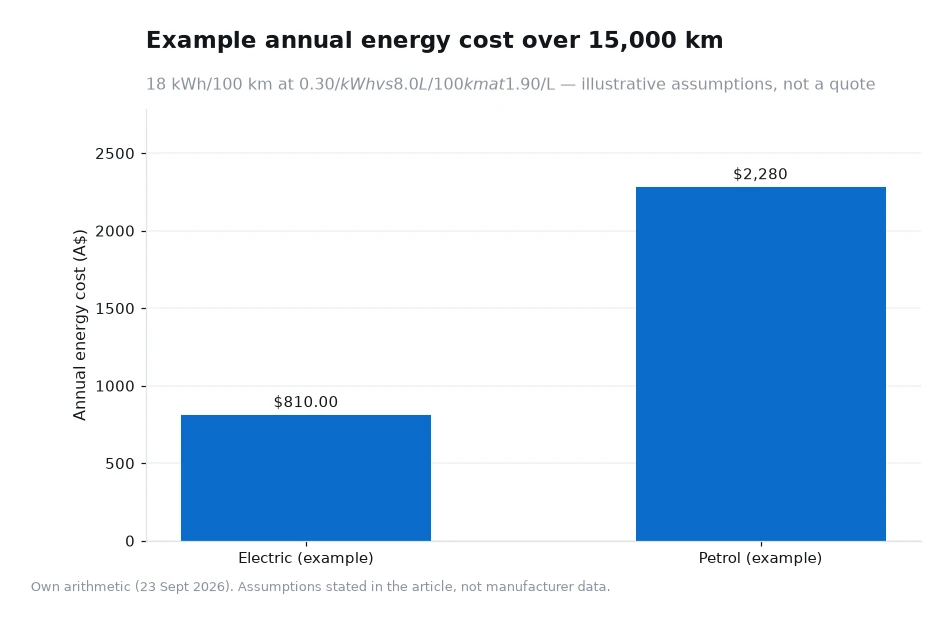
The chart below shows the same assumptions applied to a year rather than a single day: 15,000 km at 18 kWh per 100 km and $0.30 per kWh gives $810, against $2,280 for the petrol case at 8.0 L per 100 km and $1.90 per litre.
Frequently asked questions
Is a 12-minute charge enough to continue a long drive?
It restores the battery from 10% to 80% on the published figure, which on a car with up to 525 km of WLTP range is usually enough for the next few hundred kilometres; how far you actually get depends on speed, load and conditions.
How many charging stops should I plan for a long day?
A common approach, used as a labelled assumption here, is one stop every few hundred kilometres; on a 1,000 km day that is three or four stops, adding roughly 60 to 80 minutes including overheads.
Planning the next long drive
Write the plan as a list of distances rather than a list of chargers: where you will be at 300 km, 600 km and 900 km, and how much charge you need to leave each stop with. Then add the overhead to every stop before you compare the arrival time with a petrol car, because that comparison is only fair when both sides include the same minutes.
Finally, charge at home the night before rather than relying on a fast charger near the start of the route. Leaving with a full battery on a cheap overnight tariff removes one stop from the day entirely for most households.
Charging and range figures come from the manufacturer's Australian site at xpeng.com/au, read 23 Sept 2026, including the footnote that the 427 km figure is from internal tests of the G6 RWD Long Range and that WLTP figures depend on conditions. The 8-minute overhead, 300 km spacing, 20 kWh per 100 km, $0.30 per kWh, 8.0 L per 100 km and $1.90 per litre inputs are illustrative assumptions, not manufacturer data.[1]