Seven Days Is Enough to Test a Mining Pool's Claims
Pool pages make claims; a week of credits is evidence. The test is cheap because the expected output is arithmetic, not opinion: 483 TH/s should credit 0.00021668 BTC a day, $18.35 at $84,692 per BTC, and $17.62 once the listed 4% on the block-reward component is removed. If a week of statements tracks those figures, the page has been checked rather than believed.
Key takeaways
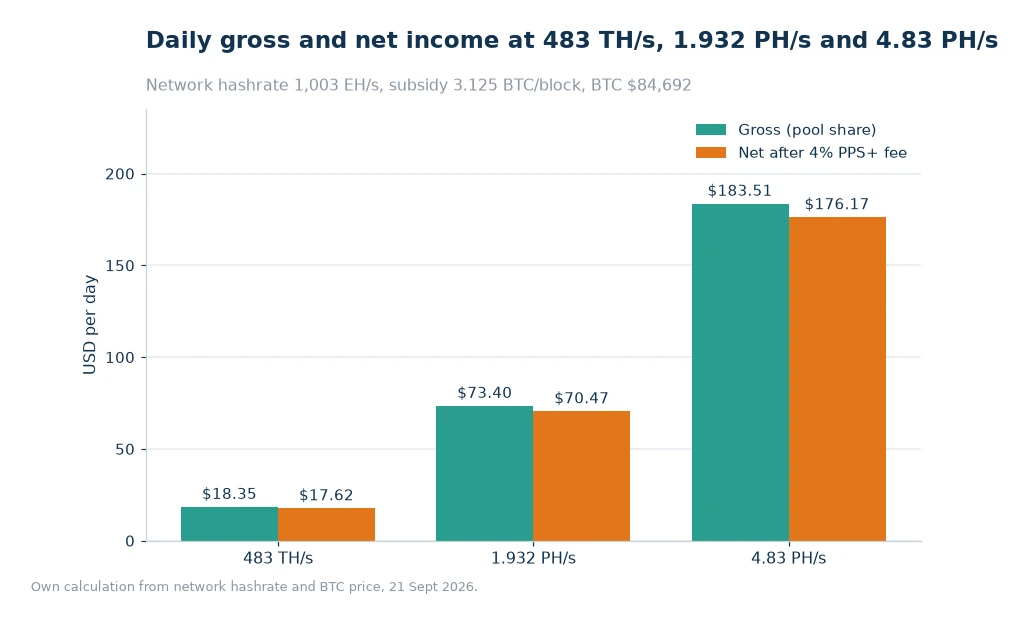
- Set the expected daily credit before the move: 483 TH/s equals 0.00021668 BTC, or $18.35 gross at $84,692.
- Check the first 48 hours closely, then compare a full seven-day total for 0.00151676 BTC.
- Judge the fee by component, not by a single percentage: 4% on the block-reward part, 2% on the fee part under PPS+.
- Any gap larger than 2% in a week has a named cause — uptime, stale shares, or a hashrate lower than the figure you assumed.
A landing page is a claim, a week is evidence
Every pool describes itself well. The words are similar, the screenshots are similar, and the fee table is usually a single number with a footnote. None of that is dishonest; it is just not testable at a glance. The testable part is what arrives in the account when your machines submit shares, and that can be measured from the first hour.
The reason to measure is not suspicion. It is that a move between pools disturbs several things at once: the worker name, the difficulty setting, the payout address, the app alerts. If something was mistyped, the result looks like a bad pool rather than a bad configuration. A week of expected-versus-actual separates the two.
Write the expectation down before the move
Do this while the old pool is still running, because after the move you will be busy. Three lines: the effective hashrate reported by your own dashboard over the past seven days, the network total on the day you check, and the price of BTC on the same day. Divide, and write the daily BTC figure in the corner of the page with the date beside it.
Effective hashrate is the number that matters, not the sum of nameplate stickers. A rig rated at 500 TH/s that reports 483 TH/s for a week is a 483 TH/s rig for the purpose of the sum, and every pool will pay it accordingly. Using the sticker value guarantees a disagreement that has nothing to do with the pool. The ViaBTC Mining Guide uses the same convention when it walks through the daily-credit calculation, which is a small point in its favor: the worked figures start from effective hashrate rather than from a product name.
Keep the page with those three lines somewhere you will find it again. A photograph on a phone is enough. The point is to fix the expectation before any new interface has a chance to reframe it, and to have the date attached, because a figure without a date is a rumour.
The first forty-eight hours
The first two days answer the configuration question. Shares should appear within minutes of the first connection, and under PPS+ the credits arrive hourly against current difficulty. Compare the first six hourly credits with the daily figure divided by 24 — at 483 TH/s that is 0.0000090283 BTC, or about $0.76 an hour.
Six matching hours means the account, the worker and the payout address are wired correctly. It does not yet mean the pool is performing, because two days can sit above or below the long-run rate by chance. That is why the next checkpoint is at seven days, where the sample is large enough for a small difference to become visible.
A week of checkpoints
The table keeps the running total at the smallest tier in the chart, so each row can be checked against a statement without extra arithmetic. The last column is the one to act on: a checkpoint that fails tells you what to look at before the next one.
| Checkpoint | Cumulative BTC | USD at $84,692 | If it falls short |
|---|---|---|---|
| 6 hours | 0.00005417 | $4.59 | Check worker name and pool URL |
| 48 hours | 0.00043336 | $36.70 | Check uptime and stale share rate |
| 7 days | 0.00151676 | $128.45 | Compare reported hashrate with your own |
Worked example
The arithmetic below is the whole test; once it is written down, a week of statements is a matter of subtraction.
- Per-terahash output: 450 ÷ 1,003,000,000 = 0.0000004486 BTC a day.
- At 483 TH/s: 483 × 0.0000004486 = 0.00021668 BTC.
- In dollars: 0.00021668 × 84,692 = $18.35.
- Listed 4% on the block-reward component: $18.35 × 0.04 = $0.73, leaving $17.62.
- Six hours: 0.00021668 ÷ 4 = 0.00005417 BTC, or $4.59.
- Two days: 0.00021668 × 2 = 0.00043336 BTC, or $36.70.
- Seven days: 0.00021668 × 7 = 0.00151676 BTC, and 0.00151676 × 84,692 = $128.45.
Scale the same lines to the larger tiers if that is your size: 1.932 PH/s is four times 483 TH/s, so the week's total is 0.00606704 BTC or $513.81, and 4.83 PH/s is ten times, for 0.01516760 BTC or $1,284.55. Because the relationship is linear, one multiplication replaces four pages of text.
What a discrepancy usually means
Short by 1% to 2%: usually stale shares or a brief restart, and not worth a support ticket. Short by 5%: look at the reported hashrate first — a single board dropping out on a multi-board machine produces roughly that. Short by 10% or more: check whether the machine is throttling, whether a second worker is pointed elsewhere, and whether the payout address is the one you think it is.
Long by 5%: that is variance, not a bonus. Under PPS+ the block-reward component is close to fixed against difficulty, but the transaction-fee component moves with network congestion and can lift a short window. Do not build a plan on a good week, and do not move pools over a bad one.
One more case is worth naming because it looks like a pool fault and is not: a machine that has been rebooted into a lower power profile. It hashes, it submits shares, and it earns less than the expectation on the page. The fix is in the firmware settings, and no support desk can find it from their side.
Frequently asked questions
How long before the first credit appears?
Under PPS+ the account is credited hourly against current difficulty, so a correctly configured 483 TH/s worker should show about 0.0000090283 BTC within the first hour or two.
Should I compare gross or net figures?
Compare net, because the statement already has the listed 4% removed from the block-reward component; at 483 TH/s the net figure is $17.62 a day against $18.35 gross.
What if the pool reports a different hashrate than my dashboard?
Small differences are normal because the pool samples shares over time, but a gap above 3% for several days usually means a board, a cable or a power profile on your side rather than a pool error.
Keep the record, not the impression
Save the week's numbers in a file named for the date of the move. Next time you consider a switch, the file gives you a baseline that was measured rather than remembered, and the same seven-day test takes ten minutes instead of an afternoon. It also makes a support conversation concrete: a worker name, a date, an expected figure and an actual one.
The ViaBTC App is the quickest way to watch hashrate and credit alerts during that week, and the pool state page gives the current network figures for the expected column. Between the two, the first week stops being a feeling and becomes a table.
Sources: ViaBTC app and pool state pages, plus the scheme descriptions on the site; chain inputs read 21 Sept 2026 — network hashrate about 1,003 EH/s, difficulty 132.76 T, 3.125 BTC per block, 144 blocks a day, BTC $84,692. Published 24 Oct 2026. Totals assume continuous uptime[1].