What to Do When an Adult AI Chat Gets Repetitive
Repetition is a symptom with three possible causes, and treating the wrong one wastes a thread you have spent weeks building. It can come from a prompt that keeps returning to the same shape, from a character whose definition has a narrow range, or from a conversation that has been stretched past what its context can carry. Each has a different repair, and two of the three do not require starting over.

Key takeaways
- Three repetition types: identical phrasing, repeated story beats, and a flattened emotional register.
- At an illustrative one recycled reply in five, a 3,600-message month contains about 720 recycled replies against 60 in a 300-message month.
- Add a constraint before adding a thread. New context usually fixes what a reset cannot.
- Reach for a reset only when the loop is structural, meaning every topic returns to the same beat.
Three kinds of repetition, three different causes
The first kind is phrase-level: the same sentence openings, the same gesture, the same three adjectives. It usually points at the prompt rather than the character, because a conversation that keeps being fed similar messages tends to answer in a similar register. Changing what you send is often the entire fix.
The second kind is structural: the exchange keeps arriving at the same beat no matter where it starts. That test is worth running deliberately - propose two unrelated directions and see whether both drift to the same place. When they do, the character definition is the constraint, and no amount of new input will widen it.
The third kind is emotional: nothing is wrong with the words, but the temperature never moves. This is the signature of a thread that has gone on long past the point where its context is helping, and it is the one case where a fresh conversation genuinely outperforms a correction.
Diagnosing in two minutes
Read the last twenty messages rather than the last three. Loops are obvious at that length and invisible at short range: you will see the same pattern of question and answer, or the same escalation that never arrives, and you will usually spot the exact message where the tone settled into its rut.
Then run the two-direction test. Ask for something specific and unrelated to the current scene, and then ask for something related to a detail from an earlier session. A character that handles both has a healthy range and the problem was your prompt. A character that folds both back into the same beat is telling you about its definition.
Finally, check whether the thread is doing any work. If continuous context is no longer improving replies, the thread has become a liability and the honest move is a new one - written, this time, with a memory note that carries over the facts worth keeping.
Fixes that add context instead of removing it
The most effective repair is a constraint. Give the exchange a condition it has not satisfied before: a slower pace, a different setting, a limit on how often something happens, a request to resolve rather than continue. Constraints change the shape of the reply in ways that encouragement cannot.
The second fix is a summary. One sentence naming where the conversation currently stands resets the context without discarding it, and it is much cheaper than a restart. Readers who describe this tactic usually call it a checkpoint, and it works because it tells both sides what the shared state is.
The third fix is a different entry point. If a thread keeps returning to the same beat, open the next session with a completely unrelated opening rather than adjusting the existing one. The accumulated context still applies, but the first message sets a new direction and the pattern has nothing to fall back into.
| Symptom | Likely layer | Cheapest repair |
|---|---|---|
| Identical sentence openings | Your own recurring prompt shape | Rewrite the next message with a named direction |
| Same story beat every session | Character definition | Try a different creator's character |
| Flat emotional range | Thread context gone stale | Checkpoint sentence, or a new thread with a memory note |
| Answers ignore the last message | Thread length past its useful point | Restart with the durable facts restated |
| Every topic converges | Definition plus a narrow content mode | Reconsider the mode you are using |
Work down the table in order rather than starting with a reset. Two of the five repairs leave the thread intact, and the thread is usually the asset you built by turning up for a month.
Worked example: putting a number on recycled replies
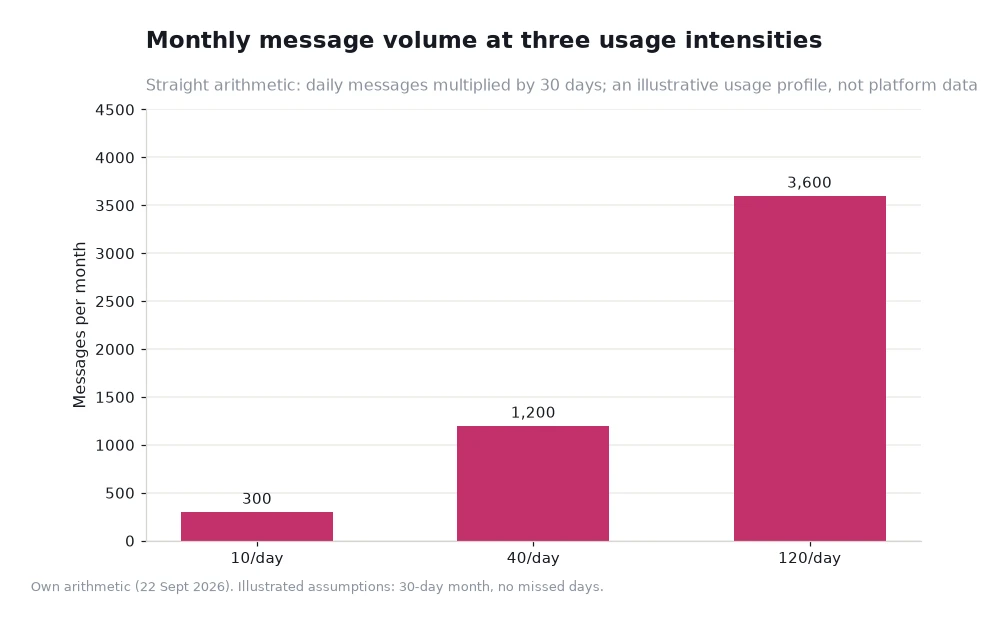
Take message volume as an illustrative assumption: 10 messages a day gives 300 a month, 40 a day gives 1,200, and 120 a day gives 3,600, on a 30-day month. Now assume, again illustratively, that one reply in five reads as recycled. The light month then contains about 60 recycled replies, the moderate one about 240, and the heavy one about 720.
The absolute numbers matter less than the ratio. A reader at 60 recycled replies a month can afford to shrug; a reader at 720 is averaging roughly 24 a day, which is a habit built on a loop rather than on a conversation. That is why heavy users benefit most from diagnosing early: the cost of delay scales with throughput.
The same arithmetic applies to fixes. A checkpoint sentence consumes one message and can reset hundreds of following ones, so the return on a thirty-second intervention is enormous at the top of the range and still worthwhile at the bottom.
When the loop is in the catalogue, not the chat
Some repetition cannot be fixed from inside a thread because it belongs to the character. The check is simple: run three different openings with the same companion and compare the directions they take. If all three arrive at the same beat, the definition is narrow and the answer is a different card, found through character search rather than more patience.
Two details also help before you blame the character. Confirm which content mode is active, since the Filtered, Unfiltered and 18+ states change what a conversation can explore, and check the creator's credit, because two characters from the same hand often share a range. Reading the platform's own description of the format it files under sex ai with Sex AI companions is a reasonable way to see how the company frames the range it intends.
Diagnose first, intervene second, and reset last. Most repetitive conversations are recoverable, and the ones that are not are usually recoverable in the catalogue instead.
Frequently asked questions
Is a reset the fastest way to fix a repetitive chat?
No. It is the last resort, because it discards the accumulated context that made earlier sessions good. Try a constraint or a checkpoint first.
Why did repetition start after a good month?
Usually because the thread reached the point where its context stopped adding anything. That is a length problem rather than a character problem, and a checkpoint often solves it.
Can a content mode cause repetition?
It can narrow what the conversation explores, which can look like repetition. Confirming the active mode is a two-second check worth doing before anything else.
Repair before you replace
Next time a conversation starts looping, read twenty messages, run the two-direction test, and add one constraint rather than starting again. If the loop survives all three steps, take it as information about the character and choose the next one from a narrower query. Adults aged 18 and over are the intended audience here.
Sources: the content modes and the response wording described above were read from Crushon on 22 Sept 2026. The one-in-five recycled reply rate and the monthly message totals are illustrative assumptions built for this article and are not platform data.[1]